




If you're heading to Dubai with a camera phone, mirrorless or full-frame DSLR the desert is going to be the most photographable part of your entire trip. Better than the Burj Khalifa. Better than the Marina skyline. Better than the souks. And most visitors completely waste it by showing up at the wrong time, going to the wrong spot or trying to capture too much without a plan.
We see it every day at TopDune Adventures. A group books a sunset desert experience, arrives with cameras out and spends the entire ride trying to take photos through windshields and helmet visors. They get back to the camp with phones full of blurry, badly-lit shots and miss the actual desert because they were too busy with the lens.
This guide fixes that.
We've spent thousands of hours in Al Badayer and Al Madam sunrise, sunset, mid-day and after dark. We've watched professional photographers fly in specifically for these dunes. We've helped travel influencers nail the shots that make their feeds. Below is everything we've learned about where to stand, when to be there and what to actually do with your camera to get desert photos that don't look like everyone else's.
What's in This Guide
-
The 60-Second Cheat Sheet
-
Understanding Dubai Desert Light (The Most Important Section)
-
The 11 Best Photography Spots
-
Best Times of Day for Each Type of Shot
-
Best Months for Desert Photography
-
Gear Recommendations (Phone, Mirrorless, DSLR)
-
The 7 Shot Types Every Desert Photographer Needs
-
Common Mistakes That Ruin Desert Photos
-
How to Plan a Photography-Focused Desert Trip
-
Frequently Asked Questions
The 60-Second Cheat Sheet
If you read nothing else:
1) Best month overall: November–February (cool weather, clear skies, low haze)
2) Best time of day: Sunrise (5:30–7:30 AM) better light AND fewer people than sunset
3) Best primary location: Al Badayer Red Dunes biggest, most photogenic, most dramatic
4) Best secondary location: Al Madam buried village completely unique, viral-ready
5) Best activity for shots: Private Luxury Safari (driver stops on demand) or a sunrise dune buggy ride
6) Worst mistake: Going at noon. The light is harsh, your photos will look flat, and the sand glare is brutal
7) Camera-agnostic truth: Timing and location matter 10x more than gear
The rest of this guide explains the why behind all of the above.
Understanding Dubai Desert Light (The Most Important Section)
Photography is light. And the Dubai desert has very specific, predictable light patterns that you need to understand to get great shots.
The Three Light Windows
1. Sunrise Golden Hour (30 minutes before sunrise → 90 minutes after)
This is the most magical light window in the entire UAE for photography. The sun is low, the air is cool and clear (no daytime haze), and the desert is empty. Shadows are long, dunes catch warm side-light, and the sky transitions through purple, pink, orange, and gold in about 20 minutes.
Best for: Landscape shots, portraits, lifestyle/travel content, drone work.
Practical timing: Sunrise varies from ~5:30 AM (June) to ~6:55 AM (December). Be in position 15 minutes before sunrise.
2. Mid-Day (10 AM – 3 PM)
Generally the worst light for desert photography. The sun is directly overhead, shadows disappear, contrast becomes harsh, and the sand reflects intense glare. Most experienced photographers don't shoot during these hours unless they're doing very specific stylized work.
Best for: Almost nothing aesthetically. Only practical for documenting an activity you happen to be doing at this time.
3. Sunset Golden Hour (90 minutes before sunset → 30 minutes after)
The Instagram-famous Dubai desert sunset. Warm light bathes the dunes from the west, the sky catches incredible colors, and shadows stretch eastward. It's beautiful but it's also when EVERY other tourist is in the desert too.
Best for: Portrait/lifestyle shots, social media content, classic "Dubai desert" imagery.
Practical timing: Sunset varies from ~5:35 PM (December) to ~7:15 PM (June). Be in position 60 minutes before sunset.
The Often-Forgotten Fourth Window: Blue Hour
The 20 minutes after sunset (or before sunrise) when the sky turns deep blue while the dunes still hold warm color. Almost no tourists are around. Phones struggle here, but mirrorless and DSLR cameras can capture genuinely stunning moody work.
Best for: Atmospheric, cinematic shots that look unlike typical "Dubai desert" content.
The 11 Best Photography Spots
Specific spots within Al Badayer and Al Madam. Some are well-known, some most photographers miss.
1. The Big Red Dune Ridge (Al Badayer)
The famous high dune ridge is the iconic shot people think of when they imagine "Dubai desert." Best photographed from the eastern side at sunrise or western approach at sunset.
What works here: Wide landscape shots, drone work, silhouette portraits against the sky.
Pro tip: Climb halfway up the ridge for an elevated perspective. Most photographers shoot from the base, which gives you the same shot everyone has.
2. The Dune Bowl Below Big Red (Al Badayer)
A natural amphitheater of soft sand below the main ridge. Used by many evening desert safari camps. The curves of the dunes around the bowl create incredible compositional lines.
What works here: Group shots, vehicle photography, action shots of sandboarding or buggies.
3. The Sand Highway (Al Badayer western edge)
A long, flat stretch of sand running parallel to the main dune ridge. Looks like a sandy road extending into infinity at sunrise/sunset.
What works here: Motion shots of buggies/quads driving toward the camera, "leading lines" landscape compositions.
4. The Northern Ridge Viewpoint (Al Badayer)
Less-photographed northern section of the Al Badayer dunes. Higher elevation, fewer footprints in the sand, and dramatic 270-degree desert views.
What works here: Aerial-style landscape shots without a drone. Sunrise lighting is particularly stunning here.
5. The Buried Village (Al Madam)
The viral abandoned village half-consumed by sand. About 12 single-story buildings filled with desert. Completely unique to Al Madam.
What works here: Editorial-style photography, moody portraits, eerie cinematic shots. Best in late afternoon (3-4 PM) when the sand still glows warm but the sun isn't blinding through windows.
6. The Open Desert East of Al Madam Town
Quieter open expanse east of Al Madam village. Less dramatic than Al Badayer but offers solitude useful when you want shots without other tourists in the frame.
What works here: Minimalist landscape work, contemplative portraits, "alone in the desert" type compositions.
7. Inside the Bedouin-Style Camp at Sunset
If you book an Evening Desert Safari, the camp itself becomes a photography location. Carpets, low tables, fire pits, hookah pipes, and traditional Arabic decor combined with sunset light = cultural lifestyle gold.
What works here: Cultural details, food photography, intimate portrait moments, "desert dinner" social media content.
8. The Camel Lineup (Most Camps)
At sunset most evening safari camps offer short camel rides. The camels themselves, especially when lined up in profile against the setting sun, make for iconic shots.
What works here: Silhouette shots, classic "Dubai desert experience" social content, animal photography.
9. The Live Fire Show Stage (Luxury Safari Camps)
Available at our Luxury Evening Desert Safari and Private Luxury Safari. Fire spinners and performers in the blue hour create some of the most cinematic shots you'll get on the trip.
What works here: Long-exposure fire trails, action portraits, atmospheric night photography.
10. Sand Ripples at Low Sun (Anywhere)
When the sun is low (sunrise or sunset), wind-formed ripples on undisturbed sand cast dramatic micro-shadows. This is one of the most beautiful, abstract photography subjects in the desert.
What works here: Macro/close-up work, abstract compositions, gallery-worthy fine art prints.
11. The Sky Itself
The desert sky is often the most photographable thing in the frame. Cloud-free winter skies show every gradient of color at sunrise/sunset. Clear nights show genuine starfields and (in winter, away from camp lights) the Milky Way.
What works here: Astrophotography (winter, away from camp), sunset gradient shots, moon-rise photography.
Best Times of Day for Each Type of Shot
| Shot Type | Best Time Window | Why |
|---|---|---|
| Landscape (wide dune shots) | Sunrise golden hour | Lower crowds, cleaner sand, dramatic shadows |
| Portrait (people in desert) | 60 min before sunset | Warm light flatters skin, classic Dubai look |
| Vehicle/action shots | Sunset golden hour | Motion blur + warm light = cinematic |
| Drone aerials | Sunrise (no other drones up) | Empty desert + low sun shadows |
| Cultural/camp content | Last 30 min before sunset | Camp activities at peak energy + good light |
| Silhouettes | 5 min before sunset | Strong backlight, clean shapes |
| Astrophotography | 1 hour after sunset | Sky fully dark, away from camp lights |
| Fire show photography | Blue hour | Fire glows brightest against dark sky |
| Abstract/macro work | Within 1 hour of sunrise/sunset | Low sun angle reveals sand texture |
Best Months for Desert Photography
Top tier (November–February):
-
Cool weather (you can shoot for hours without overheating)
-
Clear skies (low atmospheric haze)
-
Sunrise/sunset times are convenient (5:30 PM sunset = light by 4 PM)
-
Sharp shadows from low winter sun angle
Second tier (October, March):
-
Comfortable temperatures
-
Light still excellent
-
Slightly more haze than winter
Counter-intuitive winner (May–September):
-
Summer sunrise is genuinely the best light of the entire year
-
Soft, warm, dust-free morning air gives photographers a magical golden hour
-
Empty desert (no other tourists awake at 5 AM)
-
Premium machines like the Polaris RZR Pro R are easier to book
-
Trade-off: 4:30 AM hotel pickup required
Avoid photography: Mid-day in any month except December–January, sandstorm season (March–June if wind picks up).
For more detailed seasonal analysis, see our best time to visit Dubai desert guide.
Gear Recommendations (Phone, Mirrorless, DSLR)
You don't need expensive gear to capture stunning desert photos. But the right setup makes a difference.
Smartphone Photography
Modern flagship phones (iPhone 14 Pro+, Pixel 7 Pro+, Samsung S23 Ultra+) absolutely capture publication-quality desert content. What matters:
-
Use Pro/Manual mode auto-exposure overexposes sand
-
Lock focus and exposure by long-pressing on a mid-tone area of sand
-
Underexpose by -0.7 to -1 stops saves highlight detail in bright sand
-
Shoot in RAW if your phone supports it (iPhone ProRAW, Samsung Expert RAW)
-
Use the ultrawide lens for landscape shots, telephoto for compression effects
Best phone shot: Portrait mode at golden hour with sun behind subject = instant magazine-cover look.
Mirrorless / DSLR Photography
Bring two lenses if you can:
-
Wide angle (16-35mm or 24-70mm range): For landscape and environmental portraits
-
Telephoto (70-200mm or longer): For compression shots, sand-ripple details, distant dune compositions
Settings starting points:
-
Aperture: f/8-f/11 for landscapes, f/2.8-f/4 for portraits
-
ISO: 100-200 in good light, up to 1600-3200 for blue hour/night
-
Shutter: 1/250s+ for moving subjects, tripod for landscapes below 1/30s
Critical: Bring a microfiber cloth and lens-cleaning kit. Sand WILL get into your gear. Plan for it.
Drone Photography
Permits required for commercial drone use in UAE. For personal recreational use, check current UAE GCAA rules. The best drones (DJI Mini series) work brilliantly here the Dubai desert is one of the most droneable locations on Earth, with predictable winds and dramatic terrain.
Best altitude: 30-50m above dune crests for natural-feeling aerial perspective. 100m+ for true bird's-eye.
What to Bring No Matter What
-
Spare batteries (heat and sand drain them faster than you expect)
-
Memory cards (you'll shoot more than you think)
-
Microfiber cloth + sensor blower
-
Lens cap that actually stays on
-
A sealable plastic bag for between shots in windy conditions
The 7 Shot Types Every Desert Photographer Needs
Plan to capture at least these 7. They cover the full visual story of a desert experience.
1. The Iconic Wide Landscape Big sky, big dunes, no people. The "I was in the Dubai desert" establishing shot.
2. The Hero Portrait You (or your subject) in front of dunes at golden hour. Sun behind, slight backlight, smiling or contemplative.
3. The Cinematic Action Shot Buggy, quad, or vehicle in motion. Either tracking shot from another vehicle or static shot with motion blur.
4. The Detail Macro Sand ripples, footprints, the texture of a tire track. Abstract composition.
5. The Silhouette Subject against the setting sun. Clean shapes, strong backlight, no facial detail required.
6. The Cultural Moment Hand pouring Arabic coffee, camel close-up, henna being applied, fire performer mid-spin. Storytelling content.
7. The Sky-Only Shot Just sky and a hint of horizon. Sometimes the best image is 90% sky.
A 60-minute desert session at golden hour can deliver all 7 if you plan ahead.
Common Mistakes That Ruin Desert Photos
After watching thousands of guests photograph these dunes, these are the recurring problems.
1. Shooting at the wrong time. Showing up at 11 AM, complaining the photos look flat, blaming the camera. The fix is timing, not gear.
2. Auto-exposure overexposing the sand. Light sand fools every camera meter. Manually underexpose by -1 stop or your dunes will look gray-white instead of deep red-orange.
3. Trying to shoot while riding a buggy or quad. You'll get blurry junk. Either ride OR shoot — not both. Use a dedicated photo stop instead.
4. Forgetting about the wind. Hair, scarves, clothing all become uncontrolled visual elements. Either embrace the wind movement (long exposure) or shoot during calm windows.
5. Filling the frame with the wrong subject. Many tourists center their phone on themselves and crop out 80% of the actual desert. Step back. Let the desert breathe in the frame.
6. Skipping the buried village. If you're already in Al Madam, missing the buried village is a major lost opportunity. Add 20 minutes to your itinerary.
7. Not booking a photography-friendly tour. Standard tours follow a fixed schedule. Photography requires unpredictable timing; you need to stop when you want to. A Private Luxury Safari gives you driver flexibility that shared tours can't.
How to Plan a Photography-Focused Desert Trip
If you're serious about getting great photos, here's how to structure your visit.
The Ideal Photography Itinerary
Day 1 — Sunrise Recon
-
4:30 AM hotel pickup
-
5:30 AM arrival in Al Badayer (sunrise position)
-
5:30–7:30 AM sunrise photography session
-
7:30–8:30 AM continue shooting as light shifts
-
9:00 AM breakfast and rest
Day 2 — Sunset + Cultural
-
3:00 PM hotel pickup
-
4:00 PM arrive Al Madam, photograph buried village
-
5:00 PM relocate to Bedouin camp
-
5:30–6:30 PM camp life + golden hour
-
6:30 PM sunset peak
-
7:00 PM blue hour fire shows
-
7:30 PM dinner
This two-trip approach captures every light window in the desert something no single tour can do.
Best Tour Pairings for Photographers
For maximum photo control, book a Private Luxury Desert Safari your own 4x4, your own driver-guide who follows your shot requests, your own pace.
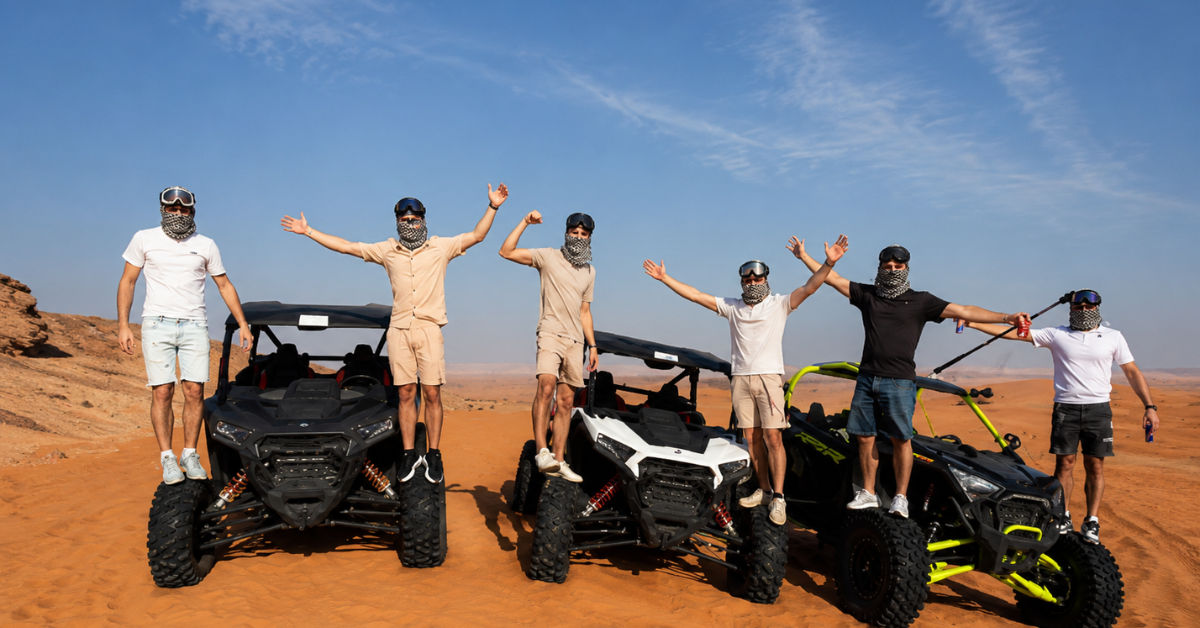
For sunrise rides, our Polaris RZR XP 2-Seater or 4-Seater gives you a vehicle to use as a foreground element AND transportation to scenic photo spots.
For dramatic visuals, our flagship Polaris RZR Pro R and Can-Am Maverick are photogenic subjects in their own right they look incredible against red dunes.
Frequently Asked Questions
Can I bring my professional camera gear into the Dubai desert?
Yes. There are no restrictions on personal photography equipment for guided tours. For commercial photography or paid shoots, you may need a permit discuss with us when booking.
Is drone photography legal in Dubai's deserts?
For personal recreational use, drones are generally allowed in designated areas of the Dubai desert with adherence to UAE General Civil Aviation Authority (GCAA) rules. Commercial drone use requires permits. Always check current regulations before flying.
What's the best month for desert photography in Dubai?
November through February for overall comfort and clear skies. For the genuinely best LIGHT, summer sunrise sessions (June-September) are unmatched but require very early hotel pickup.
How early should I arrive for sunrise photography?
In position 15 minutes before sunrise. That means hotel pickup roughly 90 minutes before sunrise to allow for travel time to the dunes.
Can I take a guided tour that's flexible for photography stops?
Yes. Our Private Luxury Desert Safari is specifically designed for guests who want flexibility. Your driver-guide accommodates your photography schedule rather than following a fixed itinerary.
Are the Al Madam buried village photos as good as they look online?
In most cases, yes but timing matters. Late afternoon (3-4 PM) gives the best light through windows and doorways. Mid-day photos look flat compared to social media versions. Sunset shots become silhouettes against the bright sky.
Do I need to tip my driver-guide for photography stops?
Tipping is optional in UAE but appreciated, especially when guides accommodate special requests. AED 50-100 is a standard guideline for excellent service on a private tour.
Will sand damage my camera?
Sand is the biggest threat to gear. Keep cameras in protective bags when not actively shooting. Change lenses in sheltered locations only. Avoid shooting in active wind. Clean equipment thoroughly after every desert trip.
Can I do photography during a regular evening safari?
Yes, but with constraints. Shared tours follow a set schedule, so you'll only have photo time during scheduled stops. Serious photographers should book private tours for time flexibility.
Ready to Make Beautiful Desert Photos?
The Dubai desert rewards photographers who plan. The right time, the right spot, the right tour and you'll come home with images that look like the ones that made you want to visit Dubai in the first place.
At TopDune Adventures, we operate across both Al Badayer and Al Madam covering every spot mentioned in this guide. From sunrise dune buggy rides for action photography to Private Luxury Safaris with photographer-friendly flexibility, our team can match the right experience to the shots you're trying to capture.
Quick Photography Booking Cheat Sheet
-
Sunrise landscape photographer? → Polaris RZR XP 2-Seater sunrise session — AED 400/30 min
-
Want maximum flexibility for shots? → Private Luxury Desert Safari — AED 1,200/vehicle (up to 6 people)
-
Want a hero-shot subject in every frame? → Polaris RZR Pro R or Can-Am Maverick — photogenic flagship machines
-
Cultural and camp photography? → Luxury Evening Desert Safari — AED 250/person
-
Just want the classic Dubai desert shots? → Shared Evening Desert Safari — AED 190/person
Browse our full fleet: TopDune Adventures Rentals →


