




If you asked most Dubai visitors whether you can see the Milky Way here, they'd probably laugh. Dubai is one of the most light-polluted cities on Earth. Burj Khalifa alone lights up 500 meters of sky. From the Marina or Downtown, you're lucky to see three stars.
But drive 55 kilometers east to the desert, and the sky transforms completely.
At Al Badayer and Al Madam, the light dome of Dubai still glows on the western horizon, but the eastern sky opens up. On a clear night at the right time of year, the galactic core of the Milky Way arches overhead in a way most Dubai residents never realize is possible. Thousands of stars. Real, unfiltered, cosmic silence.
At TopDune Adventures, we host astrophotographers regularly, professionals planning trips around new moon phases, amateur enthusiasts chasing their first Milky Way shot, workshop groups on multi-day photography retreats. This guide is written specifically for them: photographers who understand aperture and Bortle scales, who plan trips around moon phases, who know that "just show up at sunset" advice doesn't apply to night sky work.
Written from the operator side, with real Dubai astronomy specifics because generic astrophotography guides don't account for our latitude, our light pollution profile, or our seasonal weather patterns.
What's in This Guide
-
The 60-Second Astrophotography Answer
-
Understanding the Dubai Night Sky
-
Best Months for Milky Way in Dubai (Month-by-Month)
-
Moon Phases and Why They Matter
-
Best Locations Near Dubai for Astrophotography
-
Essential Equipment for Dubai Milky Way Shots
-
Camera Settings and Technique
-
Foreground Composition Ideas
-
Weather and Atmospheric Considerations
-
Practical Logistics (Overnight, Access, Timing)
-
Post-Processing Basics
-
Common Astrophotography Mistakes in Dubai
-
Frequently Asked Questions
The 60-Second Astrophotography Answer
Yes, you can absolutely photograph the Milky Way from the Dubai desert.
Best months: April, September, and October are the sweet spots of galactic core visibility combined with tolerable temperatures and typically clear skies.
Best conditions: New moon phase (moonless nights), clear weather, minimal dust in atmosphere, 40+ km from Dubai city center.
Best locations: Al Madam is darker than Al Badayer. Overnight camping is essentially required, you can't drive back and forth in the middle of the night.
Essential gear: Full-frame or crop-sensor camera, wide fast lens (14-24mm f/2.8 or wider), sturdy tripod, extra batteries, headlamp with red light mode.
Reality check: Dubai isn't Chile or the Namibian desert. You'll get real Milky Way shots, but not the darkest-sky-in-the-world quality. That's fine Dubai desert Milky Way content is still spectacular for content creators, portfolios, and personal accomplishments.
Book your overnight astrophotography session via our main rental page or explore our overnight camping options.
Understanding the Dubai Night Sky

Some quick astronomy context before diving into technique.
Dubai's Latitude
Dubai sits at approximately 25°N latitude. This positions it well for Northern Hemisphere astrophotography with these implications:
-
Galactic core (near Sagittarius) is well-elevated during summer months
-
Southern celestial pole is below horizon (Southern Cross visible only briefly)
-
North Star (Polaris) sits low at ~25° above northern horizon
-
Milky Way band rises high enough for excellent photography during peak season
Light Pollution Reality
Using the Bortle scale (1 = perfect dark sky, 9 = inner city):
-
Central Dubai: Bortle 8-9 (worst possible)
-
Dubai suburbs (Emirates Hills, Al Barsha): Bortle 6-7
-
Al Badayer: Bortle 4-5 (moderate, workable)
-
Al Madam: Bortle 4 (better, more remote)
-
Deep desert 100km+ from Dubai: Bortle 3 (excellent)
You won't get Bortle 1 quality from the Dubai desert. But Bortle 4 is genuinely excellent for Milky Way photography; the galactic core is clearly visible, star colors are distinguishable, and airglow shows.
The Western Sky Problem
Even at Al Badayer, the Dubai light dome glows visibly on the western horizon. This affects composition shoot east, south, or south-east for cleaner backgrounds. Include Dubai's glow only intentionally for artistic effect.
Best Months for Milky Way in Dubai (Month-by-Month)
The single most important thing to understand: Milky Way visibility is seasonal.
The galactic core (the bright bulge near Sagittarius that makes iconic Milky Way shots) is visible from the Northern Hemisphere approximately March through October. Outside this window, you can still shoot star fields and the fainter winter Milky Way, but the iconic core shots aren't possible.
January-February: Winter Milky Way (Limited)
Galactic core visibility: Not visible. Below horizon during shooting hours.
What you can shoot: Winter Milky Way band (fainter than summer core), star fields, Orion nebula, star trails.
Weather: Excellent cool, dry, clean air, minimal dust.
Verdict: Fine for winter astrophotography but not the classic Milky Way core shots.
March: Season Beginning
Galactic core visibility: Rises in the pre-dawn hours (3:00-5:00 AM).
What you can shoot: Early galactic core shots requiring late-night sessions.
Weather: Good — mild temperatures, occasional wind.
Verdict: For early-season shooters willing to shoot 3-5 AM sessions.
April: First Sweet Spot ⭐
Galactic core visibility: Excellent. Rises around midnight, high overhead 2-4 AM.
What you can shoot: Full galactic core, arching Milky Way band, dust lanes.
Weather: Ideal — warm days, cool nights (15-22°C), clear skies typical.
Verdict: One of the two best months for Dubai Milky Way photography.
May: Warm Excellence
Galactic core visibility: Excellent. Rises earlier (11 PM), overhead midnight-3 AM.
What you can shoot: Peak galactic core positioning.
Weather: Getting warm (20-27°C at night), occasional dust.
Verdict: Excellent visibility but bring cooling for camera gear.
June-August: Peak Milky Way + Peak Heat
Galactic core visibility: Peak. Core visible from soon after sunset.
What you can shoot: All-night Milky Way sessions possible.
Weather: Challenging. 28-35°C at night. Dust and haze are common. Camera electronics under stress.
Verdict: Best astronomical visibility BUT hardest shooting conditions. Serious astrophotographers still shoot; casual visitors should avoid.
September: Second Sweet Spot ⭐
Galactic core visibility: Excellent. Core setting mid-night hours.
What you can shoot: Full core in early night sessions (10 PM - 1 AM).
Weather: Ideal — warm days, cool nights, minimal dust, clear skies.
Verdict: The best combination of visibility and comfort. Recommended peak month.
October: Late Season Excellence
Galactic core visibility: Good. Visible in early evening hours (sunset - 11 PM).
What you can shoot: Full core with evening timing (not requiring all-night sessions).
Weather: Excellent — cooling temperatures, dry, clean air.
Verdict: Excellent for evening-only shooters. Core disappears by 11 PM.
November-December: Winter Sky Only
Galactic core visibility: Below horizon or setting immediately after sunset.
What you can shoot: Winter Milky Way, star trails, stargazing (no core photography).
Weather: Excellent — peak visibility for other astronomy.
Verdict: No core photography, but excellent for other night sky work.
Summary recommendation: Plan trips for April, September, or October the visibility/weather combination is unmatched.
Moon Phases and Why They Matter
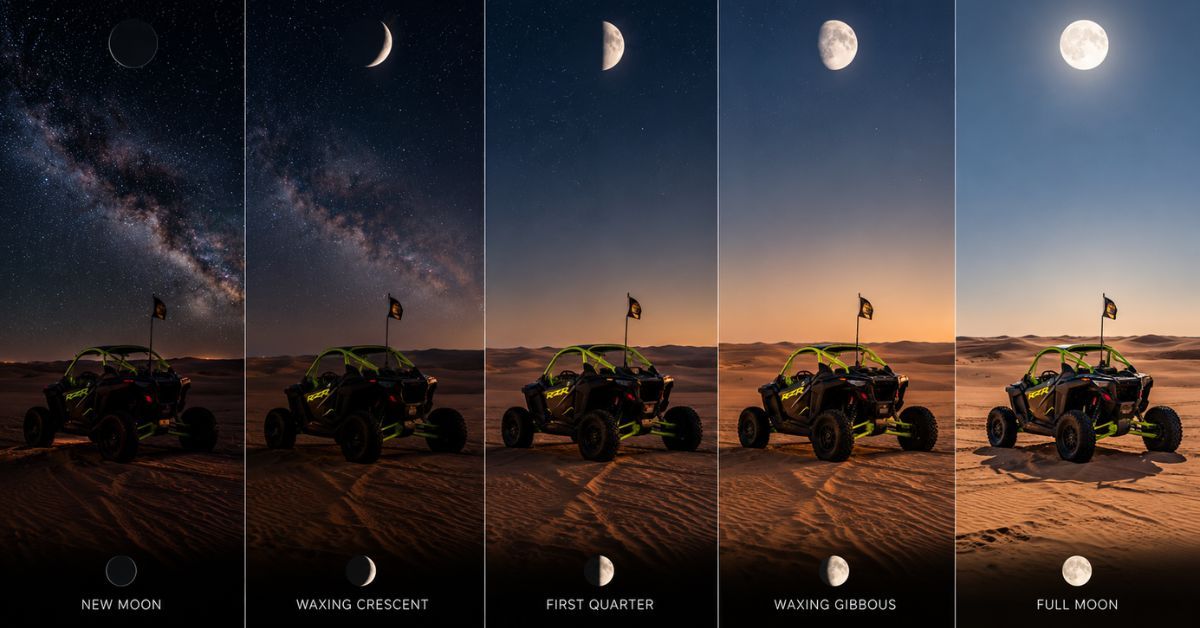
The moon is the astrophotographer's primary enemy for Milky Way work.
Understanding Moon Phase Impact
-
Full moon — washes out sky completely; Milky Way barely visible even with long exposures
-
Half moon — significant sky brightness; core visible but detail muted
-
Quarter moon — workable but limits detail capture
-
New moon — ideal; sky at maximum darkness
-
Days around new moon (3 days before, 3 days after) — the "shooting window"
Planning Around New Moons
Every month has approximately 7 days of optimal shooting (new moon + 3 days each side). Plan Dubai desert trips around these dates.
Use apps like:
-
PhotoPills (best for planning)
-
The Photographer's Ephemeris
-
Stellarium (desktop planetarium)
-
Time and Date astronomy calendar
Alternative: Moonrise/Moonset Timing
If you must shoot on non-new-moon nights, work with the moon's schedule:
-
Shoot BEFORE moonrise
-
Shoot AFTER moonset
-
Even a crescent moon setting at 11 PM gives you clean sky from 11 PM to sunrise
Real-World Planning Example
For September 2026:
-
New moon: approximately September 8
-
Optimal shooting window: September 5-11
-
Any moonless hours on other dates: check moonrise/moonset times
Book your desert accommodation and vehicle rentals during your identified shooting window.
Best Locations Near Dubai for Astrophotography
Location choice affects sky quality significantly.
Al Badayer (Sharjah)
Distance from Dubai: ~55 km Bortle rating: 4-5 Advantages: Well-established camps, easy access, fleet vehicles like Polaris RZR or Yamaha Raptor available for foreground shots. Disadvantages: More light pollution from nearby E44 highway.
Al Madam
Distance from Dubai: ~70 km Bortle rating: 4 Advantages: Darker skies, quieter, less light pollution. Disadvantages: Fewer camp options, farther drive.
Rub' al Khali Edge (Advanced Only)
Distance from Dubai: ~150-200 km Bortle rating: 3 Advantages: Genuinely dark sky, minimal light pollution, remote. Disadvantages: Requires full expedition planning, 4WD, permits in some areas.
For most photographers, Al Madam offers the best balance of quality and accessibility for Dubai-based astrophotography. Al Badayer works if you want easier access and premium vehicle foregrounds.
For detailed location comparison, see our Al Badayer vs Al Madam guide.
Essential Equipment for Dubai Milky Way Shots
Honest gear guidance for Dubai's specific conditions.
Camera Body
Ideal: Full-frame mirrorless (Sony A7 IV, Canon R6, Nikon Z6) with good high-ISO performance Workable: APS-C mirrorless or DSLR with reasonable low-light capability
Skip: Point-and-shoot or older phones (though newer Pro-mode smartphones can produce workable results)
Lens
Ideal: 14-24mm f/2.8 (Sony, Sigma, Tamron all excellent)
Workable: 16-35mm f/2.8 or 20mm f/1.8 prime
Budget option: Samyang/Rokinon 14mm f/2.8 cheap and sharp for astro
Note: Wider aperture (f/1.8 or f/1.4) helps significantly in Dubai's moderate-Bortle conditions
Tripod
Non-negotiable. Even short exposures (15 seconds) will blur handheld.
Ideal: Carbon fiber, load rating 5kg+, ball head with quick release
Workable: Aluminum, load rating 3kg+ Extra: Bring extra sand-friendly rubber feet or plates desert sand causes tripod feet to sink
Remote/Intervalometer
Reduces camera shake during exposures. Any brand-specific remote or app-controlled trigger works. Alternative: 2-second self-timer built into most cameras.
Star Tracker (Advanced)
For truly professional Milky Way work with long exposures on wider apertures:
-
Sky-Watcher Star Adventurer (best budget)
-
iOptron SkyGuider Pro (premium option)
-
Extends exposure options from 25 seconds to 2+ minutes
Support Equipment
-
Headlamp with red light mode (preserves night vision)
-
Extra batteries (cold desert nights + long exposures drain fast)
-
Lens warmer (prevents condensation in humid seasons)
-
Rain covers/silica gel (for humidity protection)
-
Weather-sealed camera bag
-
Extra SD cards (astro sessions produce lots of files)
Camera Settings and Technique
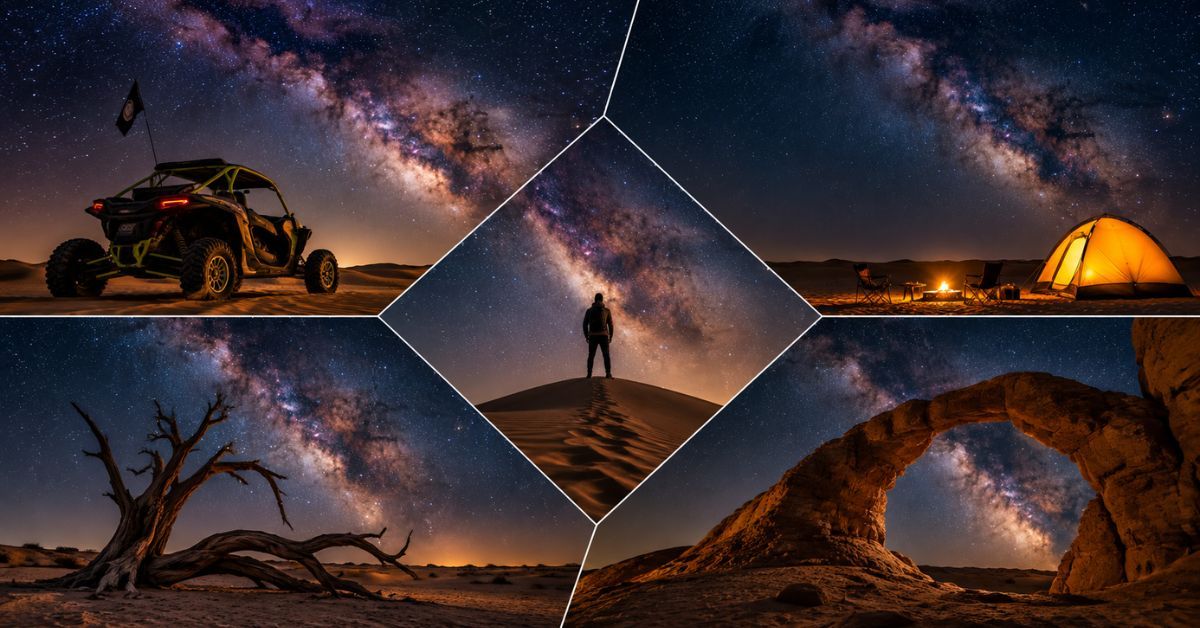
Real-world settings for Dubai desert Milky Way.
Baseline Settings for Wide-Field Milky Way
-
Mode: Manual (M)
-
Aperture: f/2.8 (widest available)
-
Shutter: 20 seconds (adjust with the "500 rule": 500 ÷ focal length = max seconds)
-
ISO: 3200-6400 (test both, pick cleaner result on your specific camera)
-
White balance: 3800-4200K (adjust in post)
-
Focus: Manual, set to infinity (or focus on a bright star during test shot)
-
Format: RAW (essential for post-processing)
The 500 Rule (and NPF Rule)
Maximum exposure time without star trailing:
500 Rule (simpler): 500 ÷ focal length = seconds
-
14mm lens: ~35 seconds
-
20mm lens: ~25 seconds
-
24mm lens: ~20 seconds
NPF Rule (more accurate): Use a calculator app like PhotoPills. Accounts for sensor size and pixel pitch. Usually gives shorter maximum times than the 500 rule.
Focus Technique
Manual focus is essential — autofocus fails in the dark.
Method 1: Focus on a bright star or distant light before it gets fully dark. Use live view zoom to 10x.
Method 2: Set to infinity based on lens markings (may need slight adjustment)
Method 3: Focus on a bright star in Live View, zoom in, adjust until the star is the smallest point.
Critical: Tape your focus ring after locking in. Bumps happen during long sessions.
Test Shot Workflow
-
Start with baseline settings
-
Take test shot, check histogram (should be well-distributed, not clipping)
-
Adjust: too dark = higher ISO or longer exposure; too bright = lower ISO or shorter exposure
-
Zoom in 100% to check star sharpness, stars should be points, not streaks
-
Lock settings and shoot your final compositions
Foreground Composition Ideas
The Milky Way alone is beautiful. The Milky Way over an interesting foreground is memorable.
Vehicle Foregrounds
Park a dune buggy or quad in the frame — see setup #24 in our Instagram photo spots guide. Options:
-
Polaris RZR Pro R — sleek profile, photographs excellently
-
Yamaha Raptor 700cc — aggressive quad silhouette
-
Can-Am Maverick 4-Seater — premium vehicle branding
Light-paint the vehicle briefly during the exposure to bring out detail.
Dune Foregrounds
Sand dune ridges create natural leading lines toward the Milky Way. Position tripod to include:
-
Ridge silhouette against sky
-
Rippled sand catching starlight
-
Distant camp lights (subtle warm glow adds depth)
Human Foregrounds
Silhouette poses in the foreground add scale and story:
-
Sitting cross-legged looking up
-
Standing arms raised
-
Two figures facing the sky together
Light-paint briefly with a warm flashlight (from the side, not front-lit) for artistic effect.
Tent/Camp Foregrounds
Overnight camp scenes make excellent astrophotography foregrounds:
-
Warm-lit tent contrasting with cool starlight
-
Fire pit ambient glow
-
Camp architecture against galactic core
Camel Silhouettes
Rare shot but iconic, desert camels resting under the Milky Way. Requires coordination with camp staff for camel positioning.
Weather and Atmospheric Considerations
Dubai desert weather affects night sky quality more than you'd expect.
Ideal Conditions
-
Clear skies: No cloud cover
-
Low humidity: 30-50% ideal (higher humidity creates condensation on lenses)
-
Minimal dust: After rain events or clean-wind days
-
Cool nights: Reduces camera thermal noise
-
No moon: Or shooting between moonset and sunrise
Checking Conditions
Sky quality apps:
-
Clear Outside (weather + astro conditions)
-
Astrospheric (excellent astronomy weather)
-
AccuWeather astronomy view
-
Meteoblue (detailed atmospheric conditions)
Check 3-5 days ahead for pattern predictions. Reassess 24 hours before your planned session.
Dust Issues
Dubai can experience dust events (natural haze) that dramatically reduce sky quality even under clear conditions. Sources include:
-
Shamal winds (northwesterly, common March-August)
-
Desert dust storms (occasional)
-
Regional pollution transport
If dust is heavy, postpone if possible or accept softer sky quality.
Condensation Management
Hot day + cool night = lens fogging. Solutions:
-
Lens warmer bands (heated bands around lens)
-
Handwarmer packs taped to lens hood
-
Frequent lens wipes (microfiber) throughout session
-
Allow camera to acclimatize before opening bag
Practical Logistics (Overnight, Access, Timing)
The reality of shooting the Milky Way from the Dubai desert.
Why Overnight Is Essentially Required
Dubai desert Milky Way work requires:
-
Being on-site during shooting hours (typically 10 PM - 3 AM depending on month)
-
Multiple hours for setup, testing, shooting multiple compositions
-
Reasonable rest before driving back
Driving 70km back to Dubai at 3 AM after 5 hours of shooting isn't practical or safe.
Solution: Book overnight desert camping. See our complete overnight camping guide.
Overnight Options for Astrophotographers
Standard overnight camp (AED 500-900) — sufficient shelter, basic amenities.
Luxury overnight camp (AED 900-2,000) — proper beds, private facilities, better rest.
Private group camp (AED 3,000-8,000/group) — full control over lighting and activities.
Timing Your Arrival
Ideal arrival: 1-2 hours before sunset for:
-
Setting up equipment in daylight
-
Testing composition frames
-
Focus verification on distant subjects
-
Astronomical twilight preparation
Astronomical twilight (when true darkness begins) is typically 90 minutes after sunset. Plan to be ready to shoot at that time.
Access and Vehicle Considerations
Standard 2WD vehicles can access most main camps at Al Badayer and Al Madam. Deep desert positioning requires 4WD or operator transport.
If bringing serious equipment, arrange for direct operator delivery to your shooting location, dune-hiking with a tripod and camera bag is challenging.
Post-Processing Basics
Bringing your Dubai desert Milky Way shots to life.
Software Options
-
Lightroom Classic (industry standard for RAW processing)
-
Adobe Photoshop (advanced editing)
-
PixInsight (specialist astrophotography — steep learning curve)
-
Starry Landscape Stacker (Mac) or Sequator (Windows) — for stacking multiple exposures
Basic Lightroom Workflow
-
Import RAW files
-
Set white balance — 4000-4500K typically works
-
Adjust exposure — usually +0.5 to +1.5 stops
-
Recover highlights — pull down highlights to avoid clipping
-
Boost shadows — lift shadows moderately to reveal detail
-
Increase clarity — moderate boost to enhance dust lanes
-
Boost dehaze — 10-20 for atmospheric clarity
-
Reduce noise — luminance noise reduction 15-25
-
Sharpen selectively — mask sharpening to avoid noise emphasis
-
Local adjustments — brighten Milky Way, darken sky edges
Stacking for Noise Reduction (Advanced)
Take 8-15 identical exposures. Stack in dedicated software:
-
Reduces noise significantly
-
Enables lower-ISO look while maintaining brightness
-
Requires alignment (star tracking helps)
Common Astrophotography Mistakes in Dubai
Errors we watch photographers make repeatedly.
1. Wrong Month Selection
Shooting in December expecting galactic core shots.
Fix: Plan trips April, September, or October.
2. Full Moon Nights
Attempting Milky Way work on bright moon nights.
Fix: Always check the moon phase; shoot near the new moon.
3. Insufficient Preparation Time
Arriving 15 minutes before dark, panicking through setup.
Fix: Arrive 1-2 hours before sunset.
4. Autofocus Attempts
Trying to autofocus in complete darkness.
Fix: Manual focus during twilight, tape to lock.
5. JPEG Format
Shooting JPEG instead of RAW.
Fix: Always RAW for astrophotography.
6. Skipping Test Shots
Diving straight to compositions without testing settings.
Fix: Always burn 5-10 test frames.
7. Not Bringing Backup Batteries
Cold nights + long exposures = dead batteries fast.
Fix: 3-4 batteries minimum for a full session.
8. Ignoring Composition
All sky, no foreground.
Fix: Interesting foregrounds separate memorable shots from generic ones.
9. Over-Processing
Cranking saturation and clarity to unnatural levels.
Fix: Aim for natural-looking enhancement.
10. Not Sharing Weather Info with Operator
Arriving at camp only to find bad conditions.
Fix: Communicate with the operator 24-48 hours before; some can help predict conditions.
Frequently Asked Questions
Can I really see the Milky Way from the Dubai desert?
Yes, from Al Badayer or Al Madam during peak season (April-October), new moon nights, and clear conditions. Dubai city has too much light pollution, but the desert 55+ km away is genuinely workable for Milky Way photography.
What's the best month for Milky Way photography in Dubai?
September offers the best combination of visibility and weather. April is also excellent. October works if you shoot in the early evening (galactic core sets around 11 PM in October).
How dark are Dubai desert skies compared to famous astrophotography locations?
Bortle 4-5 at Al Badayer vs Bortle 1 in places like the Atacama Desert. The Dubai desert isn't the darkest sky in the world, but it's genuinely good. You can see thousands of stars, the Milky Way band, and capture excellent Milky Way photography.
Do I need to camp overnight for Milky Way photography?
Effectively yes. Peak shooting hours are typically 10 PM - 3 AM depending on the month. Driving back to Dubai city after that isn't safe or practical. Book overnight desert camping through our overnight guide.
What camera settings should I start with?
f/2.8, ISO 3200, 20 seconds, manual focus at infinity, RAW format. Adjust from there based on test shots. Use the 500 rule (500 ÷ focal length) for maximum exposure time to avoid star trailing.
Can I photograph the Milky Way with a smartphone?
Modern Pro-mode smartphones (Pixel 8 Pro, iPhone 15 Pro, Samsung S24 Ultra) can capture workable Milky Way photos with astrophotography mode. Quality isn't professional but is genuinely impressive. Tripod essential.
Where should I stay for astrophotography sessions?
Overnight desert camps at Al Badayer or Al Madam. Al Madam camps offer darker skies but fewer options. Al Badayer camps have more availability and easier access. Book based on your priority.
What's the total cost for a serious astrophotography trip to the Dubai desert?
Overnight camping AED 500-1,500/person, vehicle rentals if desired AED 400-1,500, equipment rental if needed. Total serious astrophotography trip: AED 1,500-3,500 including everything.
Can I bring a telescope for astronomy observation?
Yes, and it's welcomed. Larger telescopes require setup time. Discuss with your operator before arrival to arrange safe positioning. Small tabletop telescopes are easy to bring.
Is there a specific time each night when the Milky Way is best positioned?
Depends on the month. Peak core positioning is typically 1-3 AM in April-May, 11 PM - 2 AM in June-August, and sunset - 11 PM in September-October. Use PhotoPills or Stellarium to plan precise timing.
Do you provide astrophotography workshops or guided sessions?
We facilitate overnight desert stays that suit astrophotographers and can position vehicles for photography, but we don't currently run formal workshops. We can recommend local Dubai astrophotography photographers who offer workshops for enthusiast groups.
Are there any restrictions on drones for astrophotography?
Drones require UAE GCAA registration and permission. Night drone photography is heavily restricted. Contact GCAA before planning drone-based astrophotography. Ground-based work has no such restrictions.
Ready to Photograph the Milky Way in Dubai?
Milky Way photography from the Dubai desert isn't the world-class dark-sky experience of Atacama or the Namibian desert. But it delivers something surprising: genuinely spectacular Milky Way shots from one of the most light-polluted cities on Earth. For most photographers — casual enthusiasts to serious professionals, Dubai desert astrophotography produces content that impresses viewers who assume Dubai only has city skylines.
At TopDune Adventures, we regularly host astrophotographers on overnight sessions. We can arrange overnight camps positioned for optimal sky viewing, coordinate vehicle rentals for foreground photography, and provide guidance on timing and location. Our team knows which weekend nights forecast optimal conditions and can help you plan trips around new moon windows.
Astrophotography Cheat Sheet
-
First-time Milky Way in Dubai? → Overnight camp at Al Madam, September new moon window
-
Serious portfolio shot needed? → 3-night overnight session, Polaris RZR for foregrounds
-
Content creator with brand partnership? → Overnight + Polaris RZR Pro R foreground for premium content
-
Enthusiast workshop group? → Private group overnight camp with multiple positioning options
-
Winter/off-season visit? → Skip Milky Way core, focus on star trails and winter astrophotography
-
Budget-conscious astro trip? → Standard overnight camp with your own equipment — AED 500/person
Book your overnight astrophotography session: TopDune Adventures Rentals →


